
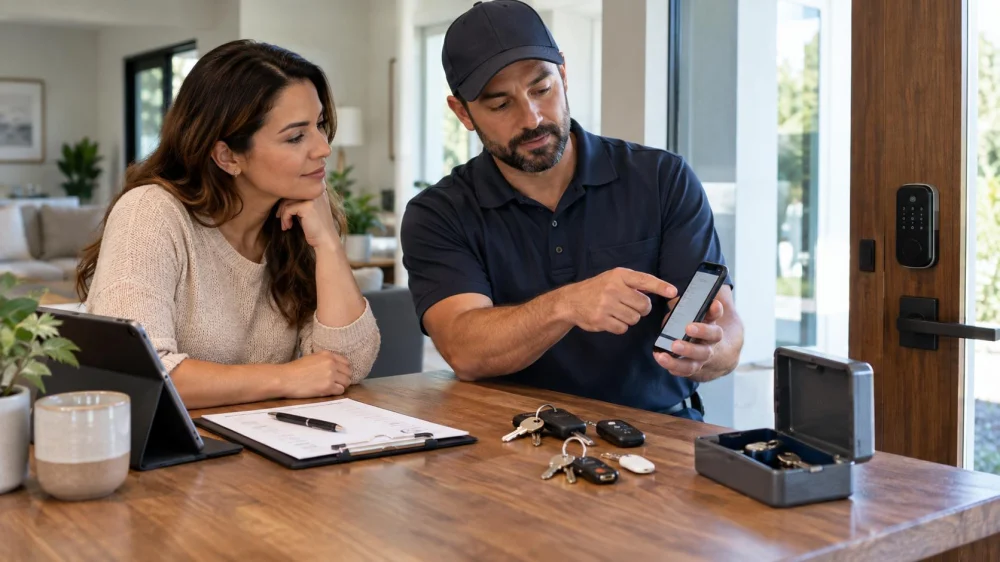
Legal Service Access Handoff: Keys, Codes, Privacy, and Records
On this page
Quick answer
For Legal Service access handoff, start by defining the exact outcome and gathering reliable, current information. The practical goal is to limit access, protect private information, document condition, and confirm return of every key and code. Use a written checklist, verify anything safety-critical with the appropriate source or qualified professional, keep dated records, and stop when uncertainty could affect health, safety, money, access, or legal rights.

Law Offices of David Mamann / law offices of david mamann
Beverly HillsLos Angeles CountyCalifornia
291 S La Cienega Blvd # 214, Beverly Hills, CA 90211, USA
What this task should accomplish
Legal service access handoff is a focused process for people who need to limit access, protect private information, document condition, and confirm return of every key and code. A useful plan separates confirmed facts from assumptions and identifies the next decision before action begins.
This guide is for customers arranging services in United States. Licensing, insurance, privacy, access, consumer rights, and contract requirements vary by location and service type.

Hanlon Law Group P.C. / hanlon law group pc
Los AngelesLos Angeles CountyCalifornia
555 W 5th St 35th floor, Los Angeles, CA 90013, USA
Pre-check checklist
- Define the desired result, location, timing, access, and exclusions.
- Verify the business identity and any qualification required for the work.
- Compare itemised scope, materials, labour, fees, schedule, cleanup, and warranty.
- Limit access to the people, keys, codes, rooms, and information actually needed.
- Keep dated estimates, approvals, photographs, receipts, and final records.
Step-by-step plan
- Describe the problem and expected outcome in plain, specific language.
- Ask how the provider will assess, perform, test, and document the work.
- Resolve assumptions and exclusions before accepting the estimate.
- Pause unplanned work until scope, price, timing, and responsibility are approved in writing.
- Inspect against the agreement and record any exception before final sign-off.
Keep the final checklist with dates, names, photos, receipts, instructions, and unanswered questions. Share only the information needed for the task and protect personal data.
Limits and important notes
A general consumer checklist cannot verify a provider, interpret every contract, or determine the technical adequacy of specialized work.
Do not grant unsafe access, disclose unnecessary sensitive information, or approve work when identity, authority, scope, price, or required credentials cannot be verified.
Frequently asked questions
What should I prepare first?
Start with the exact decision or result connected to Legal Service access handoff, then gather the most reliable current records and instructions.
How much documentation is useful?
Keep enough dated evidence to show condition, scope, decisions, and completion. Avoid collecting unrelated personal information.
When should I stop and ask for help?
Stop when safety, technical scope, health, money, access, or legal responsibilities are unclear or the situation is worsening.
Sources and evidence
The evidence basis is broad consumer-protection and professional-service practice: verify identity and qualifications, use written scope, control access, approve changes, and retain records.
Conclusion and next steps
Turn the checklist into one next action: limit access, protect private information, document condition, and confirm return of every key and code. Confirm responsibility and timing, keep the record, and revisit the plan if conditions change.





 Rowsey & Stelter, Attorneys at Law4.0 (11 reviews)
 Cook & James, LLC4.0 (100 reviews)
 Hobson & Hobson, P.C.3.0 (2 reviews)
 Witterman Law Group, LLC4.0 (3 reviews)
 Sean P. Collins PC4.0 (20 reviews)
 Swilling Family Law Firm, LLC4.0 (52 reviews)
 Legal Service Credential Check: Verify the Right Qualification
 Legal Service Access Handoff: Keys, Codes, Privacy, and Records
 Legal Document Translation: Scope, Accuracy, and Filing
 Remote Court Hearing: Test Access, Audio, and Backup
 Court Filing Redaction: Review Identifiers Before Submission
 Law Firm Payment Change: Verify Before Sending Money