
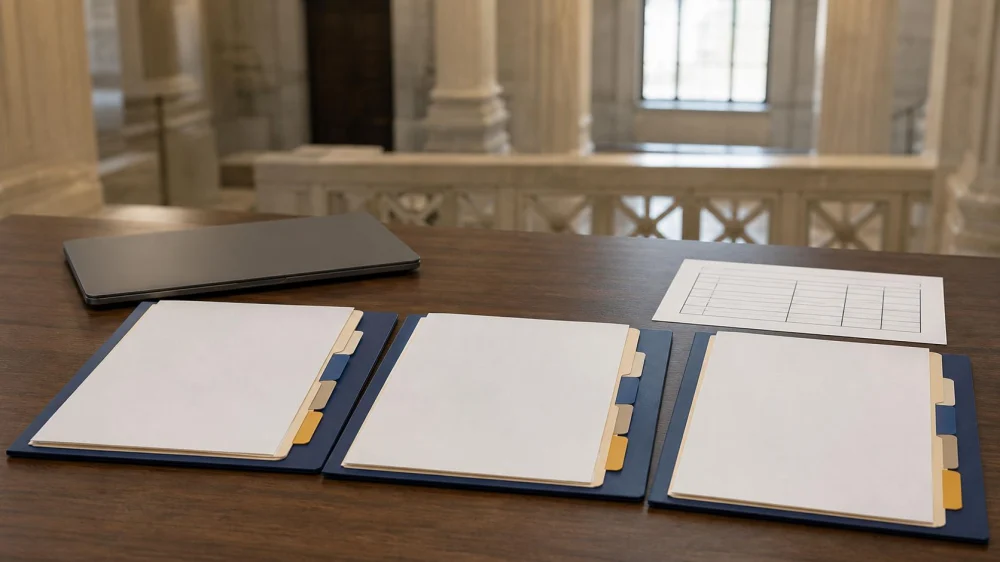
Small Claims Evidence: Organize Copies Before the Hearing
On this page
- Quick answer
- Check the court’s rules first
- Match each exhibit to an issue
- Prepare complete readable copies
- Handle photos, messages, and digital records
- Coordinate witnesses and subpoenas
- Prepare for a remote hearing
- Use the packet at the hearing
- Evidence packet checklist
- Frequently asked questions
- Sources and evidence notes
- Conclusion and next steps
Quick answer
Start with the court’s notice, local small-claims instructions, and any pre-hearing order. List what you must prove or dispute, then place each supporting document, photo, message, estimate, receipt, or contract behind a short index. Keep originals safe and prepare a complete copy for yourself, the judge, and every other party unless the court directs a different number or electronic process.
Label pages consistently and practice finding each item quickly. Do not assume a phone screen, a folder of unsorted papers, or evidence sent after a deadline will be accepted. Rules differ by state, court, judge, and hearing format.

Levin & Nalbandyan LLP / jacob nalbandyan
Los AngelesLos Angeles CountyCalifornia
811 W 7th St 12th floor, Los Angeles, CA 90017, USA
Check the court’s rules first
Read every page of the hearing notice. Confirm the court, case number, date, time, room or remote link, exhibit deadline, service or exchange requirement, file-format limits, and whether originals are required. Check the court’s official website and call the clerk about procedure when instructions are unclear.
The clerk can usually explain filing mechanics but cannot tell you what evidence will win or give legal advice. If a deadline has passed, evidence is unavailable, or the case involves a counterclaim, business entity, appeal, or large consequence, consult a licensed lawyer or the court’s self-help service promptly.

Law Offices of David Mamann / law offices of david mamann
Beverly HillsLos Angeles CountyCalifornia
291 S La Cienega Blvd # 214, Beverly Hills, CA 90211, USA
Match each exhibit to an issue
Write a one-sentence statement of the claim or defense, the amount requested, and the key facts. Break that into elements such as agreement, performance, breach, notice, causation, payment, and damages. The legal elements vary; use the applicable court instructions or legal advice rather than guessing.
Create a table for your own preparation with four columns: fact to prove, exhibit or witness, date, and any gap. A repair invoice may show an amount but not who caused the damage. A text may show notice but not delivery of a product. Identify what each item actually supports.
Prepare complete readable copies
Copy the whole relevant document, including both sides, attachments, signatures, headers, terms, and page numbers. Preserve the original exactly as received. Do not write notes on it, crop away context, improve an image deceptively, or staple over information.
Use a simple exhibit label such as A, B, C or 1, 2, 3 if the court has not required another system. Add a one-page index with a neutral description and date. California Courts advises having an original for yourself, a copy for the judge, and a copy for the other side, and organizing them so each can be found quickly. Your court may require more copies or advance exchange.
Handle photos, messages, and digital records
Export or print messages with dates, times, participants, and enough surrounding conversation to show context. Preserve the original device and full thread. For photos and videos, keep the original files, record who captured them and when, and make clear printed or court-approved electronic versions.
Do not rely on a live website or cloud link that may fail in court. Save the relevant page, date accessed, full URL, and any terms needed for context. Redact account numbers, children’s information, medical details, and other sensitive data only as court rules permit; keep an unredacted original available if required.
Evidence must also be authenticated and admissible under the applicable rules. California Courts notes, for example, that correspondence must be connected to the person claimed to have written it. An organized exhibit is not automatically admissible.
Coordinate witnesses and subpoenas
A witness with first-hand knowledge may be needed to explain a document, event, repair, or conversation. Confirm whether the witness can attend and whether remote testimony is allowed. Written statements may not replace live testimony in every court.
If a person or business will not voluntarily provide evidence or appear, a subpoena may be necessary. Subpoena forms, service methods, witness fees, objection rights, and timing are jurisdiction-specific. California Courts warns that some records can take months to obtain, so start early and use the court’s official process.
Prepare for a remote hearing
Remote hearings often require exhibits to be uploaded, emailed, filed, or exchanged before the hearing. Confirm the deadline, permitted formats, file-size limits, naming convention, and whether each party receives the same set. California Courts tells participants to contact the small-claims clerk about getting evidence to the court and the other side.
Test the link, camera, microphone, power, and internet connection. Keep a paper or offline copy of the exhibit index, case number, court phone number, and key documents. Join from a quiet private location and follow the court’s rules for recording; unauthorized recording may be prohibited.
Use the packet at the hearing
Listen for the judge’s instructions and do not hand up or display an exhibit until asked or permitted. Identify it briefly, explain what it is, how you know, and which fact it supports. Answer the question asked and avoid arguing with the other party.
Track which copies the court keeps. California Courts cautions not to walk away with an admitted court copy. After the hearing, preserve your original packet, notes, order, and any deadline for payment, appeal, correction, or enforcement.
Evidence packet checklist
- Read the notice, local rules, and pre-hearing order.
- List each fact, defense, and requested amount.
- Preserve originals and complete digital files.
- Create a numbered or lettered exhibit index.
- Prepare the required number of readable copies.
- Redact only under the court’s rules.
- Arrange witnesses and subpoenas early.
- Meet upload, filing, service, and exchange deadlines.
- Test remote-hearing technology.
- Keep the post-hearing order and deadlines.
Frequently asked questions
How many copies should I bring?
Follow the local instructions. A common starting point is one for you, one for the judge, and one for each other party, but courts vary.
Can I show evidence on my phone?
Do not rely on that. The court may require printed, filed, uploaded, or exchanged exhibits in advance.
Should I bring original documents?
Preserve originals and follow the notice about bringing them. Submit copies unless the court asks for an original.
Can I add evidence on the hearing day?
Maybe not. Pre-exchange or filing deadlines may bar late material or cause delay.
Are screenshots enough?
They may omit context and identifying details. Preserve the full thread, original device, dates, and participant information.
Will the clerk tell me what proves my case?
The clerk can explain procedure, not strategy or legal sufficiency. Use self-help resources or a lawyer for legal advice.
Sources and evidence notes
California Courts small-claims trial guidance recommends organized originals and copies and explains special handling for remote hearings. Its exhibit guide discusses identifying and authenticating different evidence types.
New York’s small-claims procedure rule illustrates that parties may need supporting witnesses, account books, receipts, and other documents. These sources are examples, not nationwide rules; use the official instructions for the court hearing your case.
Conclusion and next steps
Turn the evidence into a reliable working packet: local rules first, facts matched to exhibits, complete copies, originals preserved, and deadlines calendared. Contact the clerk about mechanics and a lawyer about legal strategy. Before the hearing, practice finding and explaining every item in a few seconds.




 Pencheff and Fraley Injury and Accident Attorneys4.0 (114 reviews)
 J Hospedales Law Firm4.0 (4 reviews)
 Law Office Of Michael Schwartz5.0 (111 reviews)
 Law Office of Donovan Bezer5.0 (2 reviews)
 rb LEGAL, LLC4.0 (44 reviews)
 Shulman & Hill Injury Lawyers4.0 (104 reviews)
 Understanding U.S. Laws on Quantum Computing Exports: Key Legal Insights
 What to Know Legally About the Use of Facial Recognition by Employers in the U.S.
 Real Estate Purchase Gone Wrong: Legal Options for Buyers in the US
 How to Protect Your Business with the Right Contracts – Expert Legal Advice
 Understanding Bankruptcy Options: What You Need to Know
 What to Know Legally About Dog Bites: Liability, Insurance & Your Rights