
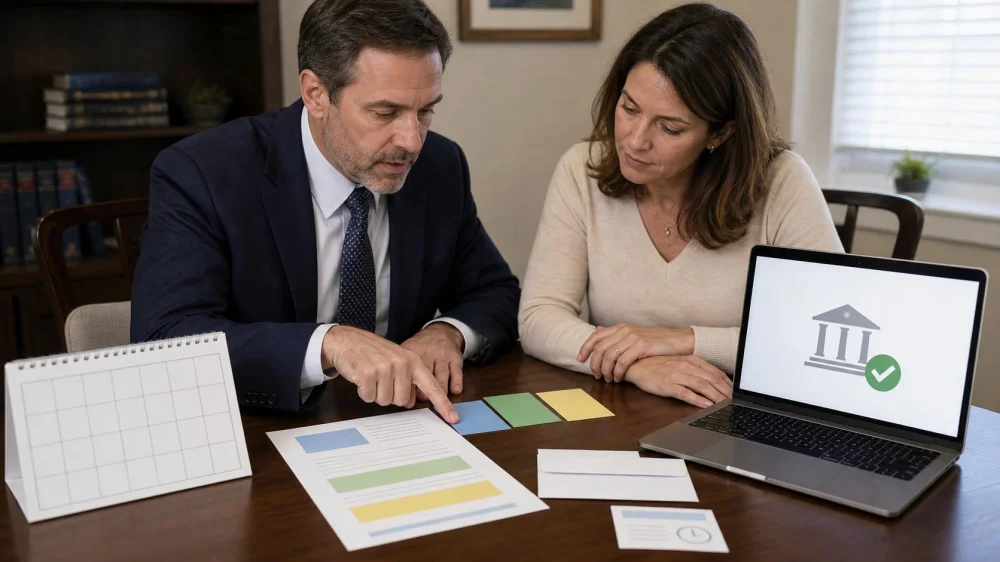
Legal Deadline Notice: Verify the Trigger and Counting Rule
A date in a letter, court order, contract, agency notice, or online docket can be critical, but calculating the actual deadline may require more than adding days. The trigger may be filing, entry, service, receipt, mailing, discovery, or another event. Preserve the notice, record when and how it arrived, and have the correct jurisdiction’s current rules verified promptly.
Quick answer
Do not rely on a generic deadline calculator or memory. Save the entire notice, envelope, email headers, docket entry, and attachments. Record the date, time, time zone, delivery method, and who received it. Identify the court, agency, contract, claim, or proceeding and the event that starts the period. Check the current governing statute, procedural rules, local rules, judge’s orders, and filing system instructions, then confirm the result with a qualified lawyer or the appropriate official resource.

Susan E. Wiesner A Law Corporation / susan wiesner lawyer
West HollywoodLos Angeles CountyCalifornia
9000 W Sunset Blvd 9th Fl, West Hollywood, CA 90069, USA
Preserve the complete notice
Keep the original in the condition received. Scan every page, including blank-looking backs, exhibits, certificates of service, barcodes, and mailing envelopes. For email or portal delivery, save the native message or download package with headers and metadata, not only a screenshot.
Record:
- who sent it and every listed party or attorney;
- the case, claim, account, or reference number;
- date shown on the document;
- filing, entry, issue, mailing, service, receipt, and download dates if available;
- method of delivery and tracking information;
- date and time someone first opened or accepted it;
- any calendar invitation or portal alert sent separately.
Do not write over the original. Put notes in a separate log linked to the saved file.

Quill & Arrow LLP / quill and arrow reviews
Los AngelesLos Angeles CountyCalifornia
10880 Wilshire Blvd Suite 1600, Los Angeles, CA 90024, USA
Identify the triggering event
Deadline language may run from “entry,” “service,” “receipt,” “notice,” “mailing,” “filing,” “denial,” “occurrence,” “discovery,” “accrual,” or another defined event. These words are not interchangeable.
A court order may be signed one day, entered on the docket another day, and served later. A contract may define notice as effective on sending rather than receipt. An agency rule may use a postmark or portal timestamp. A limitations period can depend on facts and law beyond the face of the letter.
Highlight the exact sentence that creates the deadline, but do not assume the sender stated it correctly or included extensions, exceptions, and local requirements.
Find every applicable rule
The controlling source can include:
- federal or state statute;
- civil, criminal, appellate, bankruptcy, probate, family, or administrative procedure;
- local court or agency rules;
- standing orders and the assigned judge’s individual practices;
- the specific order, scheduling order, contract, policy, or settlement;
- electronic filing and technical-failure procedures;
- rules about service method, holidays, emergencies, and extensions.
Use the official court, legislature, agency, or rules publisher and verify the effective date. A blog summary may be outdated or apply to another forum.
Verify the counting method
Questions can include whether the trigger day is excluded, calendar or court days are counted, weekends and legal holidays are included, a weekend deadline rolls forward, extra days apply to a particular service method, and the period runs forward or backward.
For example, Federal Rule of Civil Procedure 6 contains specific methods for computing periods and defines timing for electronic and other filing, but it applies only within its scope and can interact with statutes, local rules, and orders. Review the current official federal civil rules rather than treating this example as a universal formula.
Time zone matters. The filer’s location, court location, server timestamp, clerk’s closing time, or agency rule may control. Confirm daylight-saving and emergency closure effects when relevant.
Separate filing, service, and delivery
Submitting a document is not always the end. You may need a court-accepted filing, correct event code, fee, signature, exhibits, redactions, paper copies, service on parties, a certificate of service, and proof of delivery.
An upload screen or sent email is not necessarily proof of filing. Save the official confirmation, notice of electronic filing, receipt, timestamp, docket entry, stamped copy, tracking record, or clerk-issued proof required by that system.
Do not wait until the last minute. File systems can reject size, format, payment, account, or signature issues, and correction may not relate back. Learn the official technical-failure procedure in advance and preserve any error message exactly.
Build a controlled deadline record
Create one record with the matter, task, source document, trigger, rule citations, calculation, time zone, responsible person, review person, target completion date, true deadline, service task, and proof location. Record who verified each part and when.
Use layered reminders well before the deadline, but do not let reminders replace ownership. A lawyer’s case-management system may use two-person verification for high-risk dates. If new orders, amended rules, corrected notices, or rescheduling arrive, preserve the old entry and document the change rather than silently overwriting it.
Mark assumptions explicitly. An uncertain trigger is a reason for immediate legal review, not a reason to choose the later date.
Legal-advice and emergency limits
This article is general information, not legal advice and not a deadline calculation. Missing a deadline can waive rights, cause default, dismiss a claim, trigger enforcement, or create other serious consequences. Rules differ by jurisdiction, case type, party, service method, and document.
If a deadline may be near or missed, contact a licensed attorney in the relevant jurisdiction immediately. Court clerks can provide procedural information but generally cannot give legal advice or decide which rule applies to your facts. Do not ignore a notice while waiting for perfect records.
Frequently asked questions
Can I use an online deadline calculator?
Only as a secondary check after identifying the correct current rule and inputs. Generic tools may omit local rules, orders, service additions, and time zones.
Does the date on the letter start the clock?
Not always. The legal trigger may be entry, service, receipt, mailing, or another event. Verify the governing language.
Can a court clerk calculate the deadline for me?
Clerks may explain procedures but usually cannot provide legal advice or choose the controlling rule. Ask a qualified lawyer when interpretation is needed.
What if the deadline already passed?
Act immediately. Some rules allow limited relief in particular circumstances, while others are strict. Preserve evidence and get jurisdiction-specific legal advice.
Next steps
Save the complete notice and delivery evidence, identify the forum and trigger language, and locate the current official rules and orders. Create a written calculation with time zone, filing, service, and proof steps. Have it independently verified and target completion early. If any date is close or uncertain, contact qualified counsel now.





 Turner & Bowerman, LLC - Attorneys at Law4.0 (10 reviews)
 Aftalion Law Group, A.P.C.5.0 (105 reviews)
 The Law Office of Isaac Dillon4.0 (19 reviews)
 Jacqueline Torchin Carey5.0 (7 reviews)
 Bray Law Office5.0 (2 reviews)
 Goldman Legal4.0 (14 reviews)
 Understanding Employment Law for Workers: What You Need to Know in 2025
 Legal Guide to Negotiating Your First Real Estate Deal: Disclosures, Contingencies & Laws" (under 70 characters).
 Legal Guide to Joint Ventures: Negotiating Agreements and Managing Risk
 Legal Tips for Teachers Facing Wrongful Termination in Public Schools
 What Happens If You Die Without a Will – Expert Legal Advice
 Cybersecurity Breach: Legal Responsibilities of U.S. Companies