
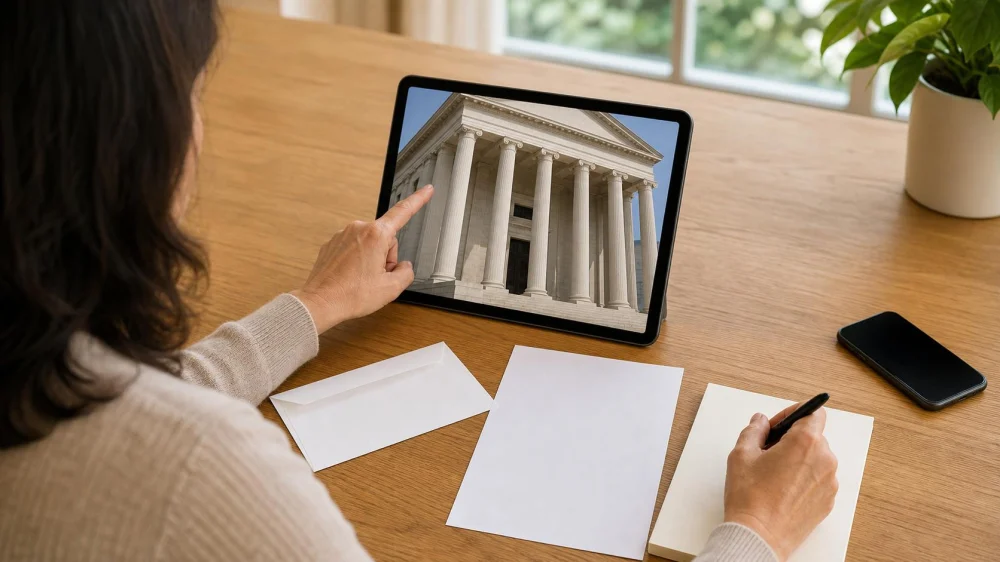
Court Notice Scam: Verify Before You Pay or Respond
On this page
- Quick answer
- Recognize urgent-payment red flags
- Do not confuse verification with ignoring a real notice
- Verify through an independent court channel
- Check the document without trusting its appearance
- Preserve the message safely
- Protect personal and financial information
- Act quickly if you already paid
- Respond to a verified real notice
- Important legal limits
- Verification checklist
- Frequently asked questions
- Official sources
- Next steps
Quick answer
If a call, text, email, or document claims you missed court or jury duty and must pay immediately, stop. Do not send money, click links, provide codes, or call the number in the message. Find the court’s official website independently, call the clerk using the published number, and verify the case, summons, or jury status. Preserve the message and any deadline while you check.
Scammers can spoof caller ID, copy seals, use real judge or officer names, and send convincing fake warrants. Appearance and personal information do not prove authenticity. At the same time, a genuine summons or court order can carry serious deadlines, so verification should be prompt.

Borna Houman Law / borna houman law
Santa MonicaLos Angeles CountyCalifornia
2530 Wilshire Blvd Third Floor, Santa Monica, CA 90403, USA
Recognize urgent-payment red flags
Federal courts and the FTC have recently warned about calls, texts, and emails falsely claiming missed jury service, arrest warrants, traffic matters, or court fines.
Major red flags include:
- a threat of immediate arrest if you hang up;
- a demand to pay during the call;
- payment by gift card, prepaid card, cryptocurrency, wire transfer, payment app, cash kiosk, or courier;
- a request for a one-time passcode or remote access to your device;
- instructions to keep the matter secret;
- pressure to stay on the line while withdrawing money;
- a text or email claiming to deliver an arrest warrant;
- a link to a look-alike court website or file upload;
- an email address that is almost, but not exactly, an official domain;
- a caller who refuses to let you verify with the clerk independently.
The FTC states that courts do not demand payment over the phone and that government agencies do not require payment by gift card, cryptocurrency, payment app, or wire transfer. Federal court warnings say they do not accept payment in exchange for avoiding arrest for missed jury duty.

Levin & Nalbandyan LLP / jacob nalbandyan
Los AngelesLos Angeles CountyCalifornia
811 W 7th St 12th floor, Los Angeles, CA 90017, USA
Do not confuse verification with ignoring a real notice
A real civil summons, subpoena, criminal notice, jury summons, administrative notice, or court order may require action. Service methods and response deadlines vary by court, case type, jurisdiction, and the person’s role.
Do not assume every email is fake or every mailed paper is real. Some courts permit electronic filing and service in certain cases; jury processes and initial service may follow different rules. Verify the exact court and document.
Write down every visible date immediately. If a stated deadline is close, tell the clerk and contact a licensed lawyer in the relevant jurisdiction. Verification efforts do not automatically extend a deadline.
If a process server delivered papers in person, preserve the envelope and full packet. Do not return or destroy the documents because someone online says they look suspicious.
Verify through an independent court channel
- End the communication. Do not negotiate or explain. Hang up, close the message, or stop the chat.
- Do not use provided contact details. A fake document can list a fake clerk number and website.
- Identify the claimed court. Note the full court name, state, county or federal district, division, and case number.
- Find the official website yourself. Use a known government court directory or carefully type the official court address. Federal courts use official U.S. Courts sites; state systems have their own domains.
- Call the clerk’s published number. Ask whether the case, jury record, warrant claim, payment instruction, and sender are genuine.
- Use the official docket system where available. Search by exact case number and party name, understanding that sealed or newly filed matters may not appear publicly.
- Ask how authentic notices are sent. The clerk can explain that court’s process without giving legal advice.
- Get legal help for a verified matter. A clerk cannot advise how to respond or defend the case.
Caller ID is not an independent channel. Scammers can make the display show a courthouse, sheriff, police department, or “U.S. Courts.” Call back only through the official published number you found separately.
Check the document without trusting its appearance
Examine a copy without editing the original. Warning signs can support suspicion, but no single visual defect proves fraud.
Check:
- whether the court name and jurisdiction actually exist;
- whether the case number format resembles the court’s official format;
- whether party names and case caption are consistent throughout;
- whether the judge, clerk, courtroom, and address match official listings;
- whether a cited rule or statute exists and applies to that court;
- whether payment goes to a person, wallet, app handle, or unusual account;
- whether links use the exact official domain;
- whether QR codes or attachments redirect elsewhere;
- whether the signature is merely an image copied from another filing;
- whether dates, locations, and instructions contradict each other.
A perfect seal and accurate case information can still be copied. Only the court or authorized counsel can confirm authenticity.
Preserve the message safely
Do not delete the communication before recording it. Save screenshots that show the full sender, phone number, date, time, message, payment demand, and link text. Export the email with headers when you know how, without opening unexpected attachments.
Keep:
- voicemails and call logs;
- texts and chat transcripts;
- email files and headers;
- envelopes, courier labels, and papers;
- URLs as plain text without visiting them;
- payment instructions, wallet addresses, and account names;
- receipts and transaction IDs;
- notes of what was said and who was present.
Do not forward a malicious attachment casually. Ask law enforcement, the court, your organization’s security team, or a lawyer for a safe submission method.
Protect personal and financial information
Do not provide a Social Security number, date of birth, driver’s license, bank information, card number, account password, one-time code, or image of identification in response to an unverified contact.
If you clicked a link or opened a file, disconnect from the interaction and use a trusted device to change affected passwords. Turn on multifactor authentication, but never read a one-time code to an incoming caller. Contact your bank or card issuer through the number on the official app, website, or back of the card.
Consider a credit freeze or fraud alert when sensitive identity information was exposed. Use the official FTC identity-theft process for a recovery plan. Tell an employer or organization promptly if the message involved a work device or account.
Act quickly if you already paid
Contact the bank, card issuer, wire service, payment app, cryptocurrency exchange, gift-card issuer, or other payment provider immediately. Say the transaction resulted from government-impostor fraud and ask whether it can be stopped, reversed, flagged, or traced.
Do not pay a “recovery agent” who promises to get the money back for an upfront fee. Recovery scams often target people whose details were already stolen.
Report the event to:
- the FTC at ReportFraud.ftc.gov;
- the relevant court’s clerk or jury office through its official contact;
- the local FBI field office or IC3 when appropriate;
- local law enforcement;
- the bank or payment platform;
- the employer or organization if work information was involved.
Save every report number. A report does not guarantee recovery, but fast notification can preserve options.
Respond to a verified real notice
Once the court confirms authenticity, ask the clerk for the public procedural information available: docket access, filing location, accepted methods, fees, hours, and official forms. The clerk cannot tell you what legal position to take.
Contact a licensed lawyer promptly, especially for a summons, subpoena, warrant, eviction, protective order, garnishment, criminal matter, appeal, or short deadline. Confirm the lawyer’s license independently.
Preserve the full packet and proof of service. Calendar the earliest possible deadline, then verify the calculation using the governing rules and legal advice. Weekends, holidays, service method, and case type can affect timing.
File only through the court’s official process. Keep a file-stamped copy, electronic confirmation, receipt, or other proof accepted by the court.
Important legal limits
Courts, jury systems, law enforcement agencies, and service rules differ across federal, state, tribal, territorial, local, and administrative forums. A statement about one federal jury scam does not define every valid court communication.
This article is general U.S. fraud-prevention information, not legal advice. It cannot authenticate a particular document, calculate a deadline, determine valid service, or tell a person how to respond to a case.
For immediate threats, stalking, extortion, or danger, contact emergency services. For a genuine arrest or criminal matter, seek qualified criminal defense counsel without making statements about the facts to an unverified caller.
Verification checklist
- Stop the call, text, email, or chat.
- Send no money and share no codes or identity data.
- Record every claimed deadline.
- Find the court’s official site independently.
- Call the clerk using the published number.
- Check the official docket when available.
- Preserve the full message and payment demand.
- Contact a lawyer if a real deadline may exist.
- Notify payment providers immediately after a loss.
- Report to the FTC and appropriate authorities.
Frequently asked questions
Can caller ID prove the court is calling?
No. Caller ID can be spoofed. End the call and use the number published on the court’s official website.
Will a court ask for gift cards or cryptocurrency?
No legitimate court resolves a missed-jury arrest threat by gift card or cryptocurrency. Do not pay; verify independently and report the attempt.
What if the fake warrant has a real judge’s name?
Scammers copy public names, seals, addresses, and signatures. Verify the document with the court clerk through an independent channel.
Should I ignore every court email?
No. Some courts and cases use authorized electronic systems. Do not click first; verify the sender, case, and court process independently and protect the stated deadline.
Can a clerk tell me what to file?
A clerk can provide public procedural information but generally cannot give legal advice. Ask a licensed lawyer about strategy and deadlines.
What if I already shared my Social Security number?
Use IdentityTheft.gov for a recovery plan, contact affected financial institutions, change passwords from a trusted device, and consider a credit freeze or fraud alert.
Official sources
- Federal Trade Commission: Jury Duty Arrest Scams explains current fake-warrant tactics, payment red flags, and reporting.
- U.S. District Court for the Eastern District of Texas: 2026 Jury Duty Scam Warning explains that federal courts do not demand payment to avoid arrest.
- Federal Bureau of Investigation: Jury Duty Scammers describes spoofed calls, official names, threats, and prepaid-card demands.
The cited alerts address common federal jury and government-impostor scams. The verification workflow is broader, but the authentic court’s rules control each real matter.
Next steps
Save the message without clicking or paying. Write down the claimed court and deadline, locate the official court website independently, and call the clerk’s published number. If the matter is real, contact a licensed lawyer promptly; if it is fraudulent, report it and notify any financial or identity provider involved.




 Law Offices of David A. DiBrigida5.0 (28 reviews)
 Barry Hogen Law | Minneapolis Criminal Lawyer5.0 (5 reviews)
 Hoover Medical Malpractice Law Firm5.0 (25 reviews)
 Jeremy R. Alm, Attorney at Law0.0 (0 reviews)
 Pansini & Pizzica4.0 (29 reviews)
 Susan E. Loggans & Associates, P.C.1.0 (92 reviews)
 Legal Guide to Trademark Infringement: What to Do and When to Hire an Attorney
 Understanding Child Custody Laws in Simple Terms: What You Need to Know in 2025
 Understanding Your Tenant Rights in Rental Disputes: What You Need to Know in 2025
 Court Docket Basics: Track Orders and Filings Carefully
 How the New Tax Laws Affect Small Business Owners in the U.S.
 What to Know About Emerging AI Laws and How They Affect Your Business