
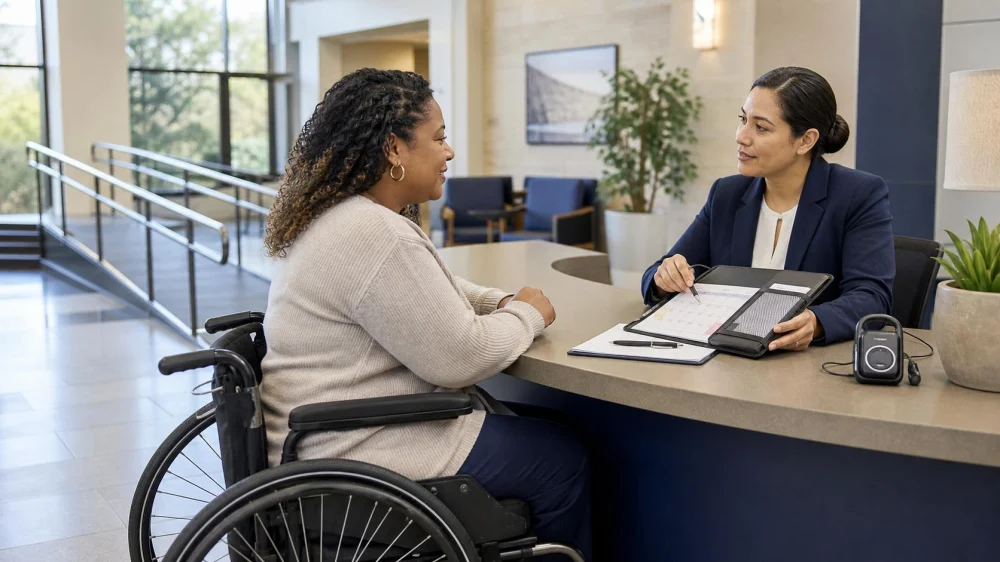
Court Accessibility Requests: Plan Before Your Hearing
Table of contents
Quick answer
Contact the court named on your hearing notice as soon as you know an accommodation may be needed. Use the court's official website to find its accessibility or access coordinator, describe the barrier and the specific aid or change requested, and ask what form or documentation applies. Obtain written confirmation and remember that an accommodation request does not automatically change a hearing or filing deadline.

The Darvish Firm, APC / elan darvish
Los AngelesLos Angeles CountyCalifornia
10940 Wilshire Blvd #800, Los Angeles, CA 90024, USA
Identify the access barrier and specific need
A useful request explains what will make participation effective without disclosing unrelated medical history. Start with the court activity involved—entering the building, passing security, communicating at a hearing, viewing exhibits, filing documents, serving as a juror, or joining remotely—and identify the barrier you expect.
Possible requests can include:
- a qualified sign-language interpreter, real-time captioning, or an assistive listening device;
- accessible electronic documents, large print, Braille, or another usable format;
- wheelchair-accessible entrances, routes, seating, witness stands, or restrooms;
- permission for a service animal or necessary disability-related equipment;
- extra breaks, modified check-in procedures, or another reasonable change; or
- accessible technology and instructions for an authorized remote proceeding.
Do not assume the same option is available in every court or for every role. A party, witness, juror, lawyer, and public observer can be covered by different local procedures.

Law Offices of Raymond Perez / raymond perez attorney
Los AngelesLos Angeles CountyCalifornia
5161 Pomona Blvd Suite 208, Los Angeles, CA 90022, USA
Find the correct court's local process
Read the hearing notice for the full court name and division. Then independently locate that court's official website. Search its pages for terms such as “accessibility,” “disability accommodation,” “access coordinator,” or “ADA coordinator.” Use the official contact details, not a number copied from an unverified message.
State and local courts are government programs generally covered by Title II of the Americans with Disabilities Act. Federal courts follow federal judiciary policy and court-specific procedures; official federal court pages may explain that the ADA itself does not apply to the federal judiciary while still describing available accommodations. This distinction is one reason to use the exact court's instructions rather than a generic form found online.
Make the request as early as possible
Some aids require scheduling, equipment, vendor coordination, or document conversion. Submit the request promptly after receiving the hearing date. If the court states an advance-request period, follow it; if the date has already passed, contact the coordinator anyway and explain the timing.
Include the case number if required, the date and location of the proceeding, your role, a reliable way to reach you, the barrier, and the requested accommodation. Ask whether supporting information is needed and how the court protects confidential medical information. Send sensitive records only through the method the court authorizes.
Keep a copy of the request and note when, where, and to whom it was sent. If you request by phone, follow up through an approved written channel when possible.
Ask about communication access
Effective communication can depend on the setting. An assistive listening device may help one person, while another may need an American Sign Language interpreter or Communication Access Realtime Translation. A person with a vision or print disability may need accessible digital documents or another format in time to review them.
Describe the communication task, not just a diagnosis. For example, explain that you must hear testimony, speak with the judge, read exhibits, or complete juror materials. Ask who arranges the service, where equipment is collected, whether a test is available, and whom to contact if the aid fails.
Plan physical and remote access
For an in-person appearance, confirm the accessible entrance, parking or drop-off point, security process, courtroom floor, seating, and restroom route. Ask whether mobility equipment can pass screening and whether early entry is possible if lines or crowds create a barrier.
For a remote proceeding, verify that remote participation is authorized; an accessibility request alone does not necessarily convert an in-person hearing. Ask about compatible captioning, keyboard navigation, screen-reader access, dial-in alternatives, and a technical-support contact. Test the approved platform in advance without sharing the private hearing link.
Get confirmation and prepare a backup
Request written confirmation that states what the court approved, the date and location covered, arrival instructions, and the coordinator's contact information. If the response differs from what you requested, ask how it will provide effective access and whether the court has a review or grievance process.
Bring the confirmation on the hearing day. Arrive with enough time to locate the coordinator or equipment. If the accommodation is missing or fails, notify courtroom staff promptly and make a factual note of the problem, the time, and the person contacted. Do not leave a required proceeding without asking the court what to do.
Accessibility request checklist
- Verify the full court, division, case number, hearing date, and your role.
- Locate the court's official accessibility page and coordinator.
- Describe the access barrier and the specific aid or modification requested.
- Follow the local form, timing, and secure-document instructions.
- Save proof of submission and every response.
- Confirm arrival, security, equipment, interpreter, captioning, or remote-access details.
- Calendar all hearing and filing dates separately from the request.
- Bring confirmation and a coordinator contact on the hearing day.
Limits and legal-help triggers
This article offers general U.S. legal information, not legal advice. Accommodation rights and procedures depend on the court system, the requested change, your role, and the proceeding. An access coordinator can manage accessibility logistics but generally cannot advise you about claims, evidence, deadlines, or whether to file a motion.
Contact a licensed lawyer or recognized disability-rights organization promptly if a request is denied, the proposed option will not provide effective access, the court asks for unusually broad medical records, or lack of access may affect a deadline or your ability to participate. A lawyer can also determine whether a litigation-related change—such as more time to file—must be requested by formal motion rather than through the administrative accommodation process.
Frequently asked questions
Do I have to use the words “reasonable accommodation”?
Usually, the practical content matters most: identify the disability-related barrier and the change or aid you need. Still, use the court's own form and terminology when it provides them.
Can I wait until the hearing day?
Ask as early as possible because interpreters, captioning, equipment, or accessible formats may require advance coordination. If a need arises late, contact the court immediately rather than assuming nothing can be done.
Does requesting an accommodation postpone my hearing?
No automatic postponement should be assumed. Continue to follow the existing order and deadlines unless the court enters a change. Ask a lawyer whether a formal motion is needed.
Can the same coordinator handle every federal court?
No. Federal courts publish court-specific contacts and procedures. Contact the court where your proceeding is pending, because another court's coordinator may lack authority to help.
Official sources
- ADA.gov: Guide to Disability Rights Laws
- ADA.gov: Americans with Disabilities Act, as Amended
- USA.gov: Federal, State, Territory, County, and Municipal Courts
- U.S. Court of Federal Claims: Accessibility Accommodations
- U.S. Court of Appeals for the Ninth Circuit: Disability Access Information
Conclusion and next steps
Turn the need into a concrete plan: find the correct court's official process, describe the barrier and requested aid, submit early, and obtain confirmation. Keep legal deadlines on a separate track, test any equipment or remote access when possible, and seek qualified help quickly if access problems could affect meaningful participation.





 Staten Island Personal Injury Attorney at Law, Brandon J. Broderick4.0 (119 reviews)
 Schwartzapfel Lawyers P.C.4.0 (69 reviews)
 Rankin & Gregory, LLC (RG Injury Law)5.0 (129 reviews)
 The Harris Law Firm3.0 (7 reviews)
 Brandon J. Broderick, Personal Injury Attorney at Law5.0 (147 reviews)
 Edelstein Law5.0 (4 reviews)
 Understanding Your Tenant Rights in Rental Disputes: What You Need to Know in 2025
 How to Legally Manage a Business Exit When You Own Foreign Assets
 The Basics of Intellectual Property Rights
 A Beginner’s Guide to Small Claims Court
 A Step-by-Step Guide to Writing a Will - Legal Steps You Need to Take
 What to Know Legally About U.S. Laws Governing Quantum Computing Exports